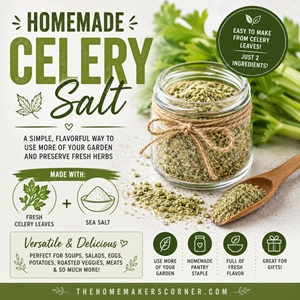
If you grow celery in your garden, don’t throw away those leafy celery tops! The leaves are packed with flavor and can be dried and turned into homemade celery salt.
This post may contain affiliate links.
Homemade celery salt is an easy seasoning to keep in your pantry, and it’s a great way to use more of the celery plant instead of letting the leafy tops go to waste.
You can use it to season soups, vegetables, potatoes, salads, eggs, meats, and even homemade dressings.
It’s also a wonderful addition to a collection of homemade seasoning recipes.
Why Make Your Own Celery Salt?
Making celery salt at home is incredibly simple, especially if you already have celery growing in your garden.
- Uses celery leaves that might otherwise be discarded
- Requires just two ingredients
- Easy to make with fresh garden celery
- Makes a versatile homemade seasoning
- Great for homemade pantry staples
- A simple way to preserve fresh herbs and vegetables
Ingredients
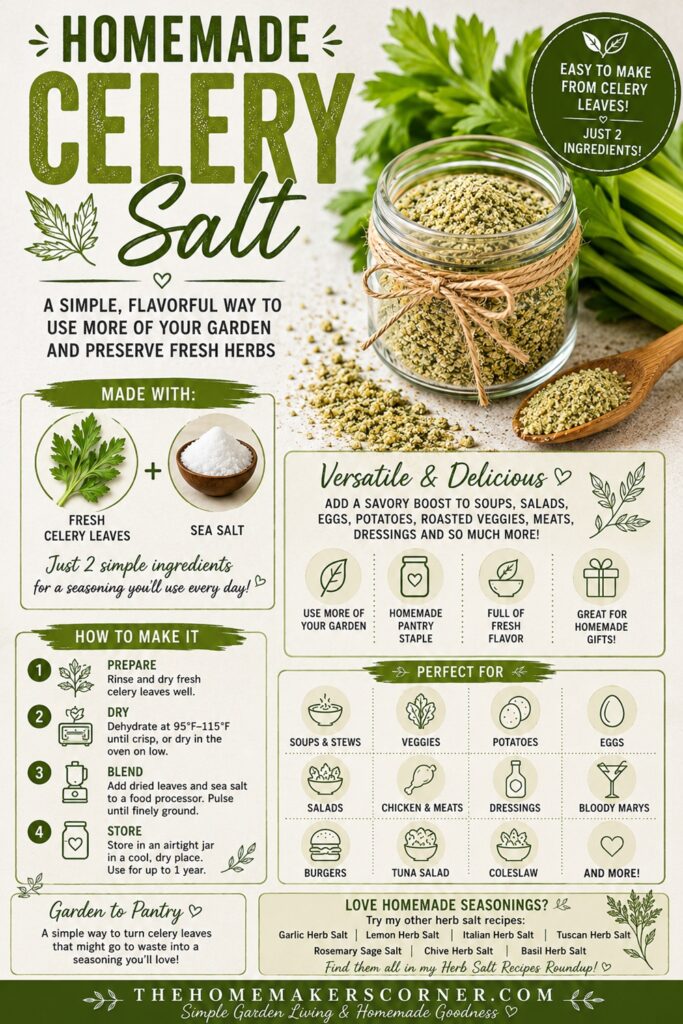
You only need two ingredients:
- 1 cup fresh celery leaves
- 1/2 cup coarse sea salt or kosher salt
You can adjust the ratio depending on how strong you want the celery flavor to be. For a milder celery salt, use a little more salt.
Want to try making your own jelly at home?
Get my free guide with 8 easy, beginner-friendly jelly recipes you can confidently make.
How to Make Celery Salt
1. Prepare the Celery Leaves
Separate the leaves from the celery stalks and rinse them well to remove any dirt or grit.
Pat the leaves dry with a clean kitchen towel.
It’s important to remove as much moisture as possible before drying them.
2. Dry the Celery Leaves
Spread the celery leaves in a single layer on a dehydrator tray.
Dehydrate at about 95°F to 115°F until the leaves are completely dry and crisp.
You can also dry them in an oven set to its lowest temperature. Keep an eye on them and remove them as soon as they are completely dry.
The leaves should crumble easily between your fingers when they’re ready.
3. Combine the Celery and Salt
Once the celery leaves are completely dry, add them to a food processor along with the salt.
Pulse several times until the celery leaves are finely ground and evenly distributed throughout the salt.
You don’t need to turn the mixture into a powder. I like leaving it slightly coarse so you can still see the little pieces of dried celery.
4. Store Your Celery Salt
Transfer the finished celery salt to a clean, dry glass jar with a tight-fitting lid.
Store it in a cool, dry pantry away from moisture.
Make sure the celery leaves are completely dry before mixing them with the salt. Any remaining moisture can cause the mixture to clump and can shorten its storage life.
How to Use Homemade Celery Salt
Celery salt is surprisingly versatile. Once you have a jar in the pantry, you’ll probably find yourself reaching for it more often than you expected.
Try it on:
- Soups and stews
- Potato salad
- Coleslaw
- Deviled eggs
- Scrambled eggs
- Roasted potatoes
- Roasted vegetables
- Fresh tomatoes
- Chicken
- Burgers
- Meatloaf
- Homemade salad dressings
- Bloody Marys
- Tuna or chicken salad
- Homemade dips
It’s especially good in recipes where you want a little extra savory flavor without adding a lot of additional herbs.
Can You Use Celery Stalks?
For this recipe, I recommend using the leaves rather than the stalks.
Celery stalks contain much more moisture and are more difficult to dry completely. The leaves dry quickly and have a concentrated celery flavor, making them ideal for homemade celery salt.
And if you’re growing celery yourself, this is a great way to use the leafy tops that are often overlooked.
More Homemade Herb Salts
If you enjoy making your own seasonings, try some of my other homemade herb salt recipes:
- Rosemary Sage Herb Salt
- Everyday Sage Herb Salt
- Lavender Herb Salt
- Chive Herb Salt
- Basil Herb Salt
- Dill Herb Salt
- Garlic Herb Salt
- Rosemary Herb Salt
- Lemon Herb Salt
You can also find even more ideas in my Homemade Herb Salt Recipes roundup.
Make Your Own Homemade Seasonings
I love recipes like this because they make the most of what you’re already growing.
A handful of celery leaves that might normally end up in the compost can become a useful homemade seasoning that you can keep in your pantry for months.
Once you start making your own herb salts and homemade seasonings, it’s fun to experiment with different combinations.
You can use whatever herbs are growing in your garden and create seasoning blends that are completely your own.
This celery salt is a simple place to start—and a great way to turn your garden harvest into something you’ll use all year.
Follow my homemade pantry board on Pinterest.